Mushrooms, Bulls, Lions & Bees - OH MY!
SHAN BEASTE - SEPTEMBER 2026
What happens when we stop assuming that an ancient symbol has only one meaning?
The bee can be an actual bee, a source of honey, a model of society, a priestess, a soul, a creature of the underworld, a seasonal marker, or an image of transformation. The bull can be an animal, fertility, agricultural abundance, Taurus, the sacrificial animal, or the substrate from which something else emerges.
There is a particular kind of discovery that happens when you stop looking for an answer and start following a pattern.
You notice something once. Then again. Then somewhere completely unexpected.
A bee appears beside an underworld goddess. Mystery rite priestesses are named after bees. A bull becomes the source of bees. Honey is placed in tombs, or even freakier, on dead bodies within those tombs. Phallic mushroom imagery appears alongside bees in cave paintings. The Pleiades, sometimes associated with a swarm of bees, appear and disappear with the agricultural year. Ancient artwork illustrates a lion with a bee in his mouth, while elsewhere a lion consumes a swarm of bees in the night sky.
At first, these things seem unrelated.
This research began with fellow Djed Eye writers Melissa Campbell and Ryan Seven, with Melissa's name being the lodestar that inspired us to conspire on what we originally began exploring through ancient priestess cults, rites and medicine. It did not take long before our respective muses began connecting dots between imagery related to fertility, death, rebirth, bulls, honey, bees, mushrooms, astronomy and mythology. Our heads were swimming with concepts, determined to come to an understanding of what these symbols could have meant to ancient minds. There were many beautiful “Eureka!” moments and a few “Are we ever going to figure this out?” moments.
Of course, by now we have immersed ourselves so completely in the imagery and connections that it all seems very obvious. This is not to say that we have all of the answers. There is much more to see, and this article does very little justice to everything we have accumulated in our research. You can find two full-length videos at Melissa Campbell’s Mercurial Pathways channel on YouTube where we discuss these subjects in greater depth and where you will also benefit from the unique perspectives of the researchers mentioned above. You will also find content related to this article at Ryan Seven’s YouTube channel as well as my own Modern Mēdwa channel.
What I hope to achieve here is to pique your interest and guide you to the water. My hope is that you drink deeply and that this information aids you in your own quest to connect your mysterious dots.

Image: Gold Bees from Eastern Greece, 7thc BC, Nasher Duke Museum, NC.
WHY DO BEES, BULLS, HONEY, MUSHROOMS, DEATH, FERTILITY & REBIRTH APPEAR SO OFTEN TOGETHER IN ANCIENT TRADITIONS?
Perhaps because they are all part of the same seasonal story.
Rather than viewing Taurus, Leo, Virgo and the other constellations through the modern lens of zodiacal personality or twelve equal divisions of the year, we can look through an older observational lens of heliacal and acronychal risings, seasonal phenomena and parapegmata: the practical star calendars by which ancient peoples tracked weather, agriculture, sailing and animal husbandry. What mattered was not simply what sign it was, but what was rising, setting, appearing, disappearing and happening on the ground at the same time.
Through this lens, the Bull becomes more than a constellation. Spring brings calving, abundant pasture, increased milk production, grazing and the accumulation of manure. Cattle themselves become agents in a larger ecological process. Grass feeds the animal, the animal feeds the soil, moisture activates microbial and fungal life, and fungi transform what has died into new biomass.
This creates an intriguing ecological bridge between bull and mushroom.
Psilocybin species that grow in herbivore dung are directly dependent upon the activity of grazing animals. Rain, moisture, dung, temperature and seasonal cycles converge to produce their visible fruiting bodies. Much of the fungal organism remains hidden before the mushroom suddenly emerges into view.
The Bull represents fertility, biomass, earthly abundance and generative life.
The mushroom represents hidden growth, moisture, decomposition, regeneration and emergence from the earth.
Both participate in the same fundamental cycle:
growth → abundance → decay → transformation → emergence
And then we encounter the bees.
The Pleiades were among the ancient world's important seasonal markers, their heliacal and acronychal appearances helping communities recognize agricultural and pastoral transitions. They were also associated with bees and conceived in some traditions as a swarm or cluster. Like the bees themselves, the Pleiades appear and disappear according to the seasonal rhythm of the sky.
This gives us another correspondence.
As the Sun dominates the summer sky, the Pleiades disappear from visibility. Later, as that period of intense solar brightness passes, they return to the predawn sky. The ancient image of a lion consuming a swarm of bees can therefore be read, at least potentially, as a visual expression of celestial disappearance: the Lion's solar dominance obscuring the Bees.
Meanwhile, the summer landscape reaches another kind of abundance. Flowers, nectar and bee activity culminate in the honey season. Honey becomes more than food: it is nourishment, offering, medicine and an extraordinarily effective preservative.
Then autumn arrives.
The rains return. What has been building unseen beneath the earth becomes visible again. The fungal network that survived the dry season produces its fruit. The agricultural cycle moves from harvest toward dormancy, decomposition and preparation for another emergence.
This is where the Eleusinian Mysteries become especially interesting. They occurred within a fixed lunar-seasonal window in Boedromion, around September and October, at the threshold between the completed harvest, the return of autumn moisture and the descent toward winter. Demeter and Persephone give this agricultural transition a mythic language: abundance, loss, descent, concealment and return.
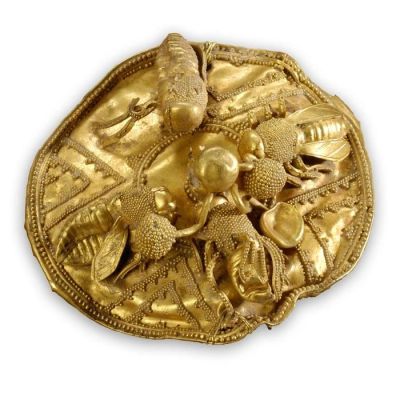
Image: The Omphalos stone, which is from the Oracle at Delphi, Greece. It is covered with what look like sculpted engravings of Honeybees. This was used as a symbol indicating that Delphi in Greece was the centre of the world. Pythia, Apollo’s chief oracle priestess was also known as the Delphic Bee. The Omphalos represents the re-generative faculties of the lower abdomen, often called "the world".
THE BEE
What is the human fascination with bees?
Fabulous pollinators who keep our agricultural world functioning certainly provide one answer. Another emerges when we look at the pastoral literature of Virgil and writers such as Sir James George Frazer, who also considered the bee a powerful metaphor for discipline, monarchy and civic order.
Ancient Greek priestly traditions add another layer. Bees were imagined as having a king or rex bee, reflecting the divine order of the hive. We now know that the colony is organized around a queen rather than a male king, a distinction that was not understood in the modern biological sense until much later.
This becomes especially interesting when we encounter the Pythia, sometimes described as the Delphic Bee, and Melissa, “the bee,” as a title associated with high priestesses and mystery traditions.
Why would mystery rites, which are so deeply chthonic, be led or represented by bee priestesses?
Why is honey so common in chthonic rites?
And what is this ancient spiritual obsession with the bee?
I do not want to go into the magical science of bees here: their wing vibrations, communication through dance and pheromones, the medicinal properties of honey, or the extraordinary organization of the hive. You would be reading my book rather than a brief article if I went into all of the magic of the honeybee.
Instead, I invite you to look through a royal-jellied lens, where things become a little dreamlike and full of wonder.
The bee can occupy an almost Mercurial position between worlds. It leaves the hive, moves through the living landscape, enters flowers, gathers nectar and returns to the darkness of the hive carrying something transformed. It travels between worlds and returns with nourishment.
This is part of what makes the bee such a compelling psychopompic image.
I became particularly interested in the idea of pneuma, the Greek word for breath, wind or spirit. Honey could be understood as containing something gathered from the living world. The bee enters darkness and returns with something sweet, medicinal, preserving, life-giving and powerful.
The hive itself becomes a kind of womb. The bees retreat into it as autumn advances, cluster through winter around their queen, and emerge again in spring when the landscape begins its annual renewal.
The bee disappears and returns.
So does Persephone.
So does the Moon.
So do the Pleiades.
So does the mushroom.
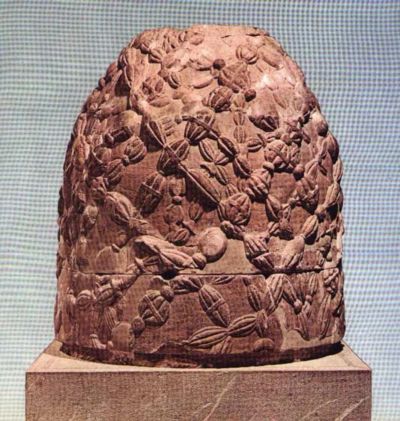
Image: Aristaeus Inventor Mellis.
ARISTAEUS & THE SECRET OF THE BEES
Around this point it is useful to mention Aristaeus.
Aristaeus' great claim to fame was beekeeping, a significant branch of agriculture in the ancient world. Apollonius calls him the honey-loving shepherd who discovered the secret of the bees.
And naturally, the secret was not something he figured out alone.
He was taught the art of apiculture by female divinities, the nymphs associated with the bees. Here we have another strange little thread: the secrets of the bees are given to a shepherd by female beings associated with honey and sweetness.
He is not simply a beekeeper. He is initiated into the hidden knowledge of the hive.
And that word, secret, keeps getting interesting when we follow the bees.
Aristaeus instructed country-dwelling people in countless things. He is said to have first brought the gentle bees from the oak and shut them up in hives, living among the nymphs who had the bees in their keeping.
According to Pliny, Aristaeus also invented honey and the mixing of wine with honey.
But Aristaeus' most memorable appearance as a beekeeper comes in Virgil's fourth Georgic.
Here we are told that his father Apollo was surnamed Thymbraios. The name is connected, in this interpretation, to thymbra, Satureja thymbra, savory, a member of the Lamiaceae or mint family alongside rosemary, oregano and thyme, plants important to bees. Thyme in particular appears repeatedly in ancient discussions of bees and honey.
In modern Greek, Thymbraios Apollo could be called riganas, meaning “man of oregano.” Interestingly, riganas was also the name used in Central Greece for the saint associated with protecting beekeepers and apiculture, a role that Apollo himself was credited with in the Homeric Hymn to Hermes.
The connections keep multiplying.
In Latin, oregano is called satureia, associated with the Satyrs, who, according to Ovid, discovered apiculture.
And then there is Thymbra, also the name of a city of Troy, founded by Dardanos.
Dardanos brings us back to the bee once again. His name has been connected with darda, a word meaning bee in the Hesychian lexicon, before its later correction by Latte.
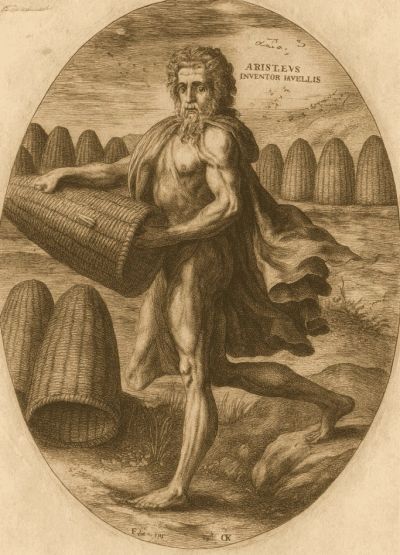
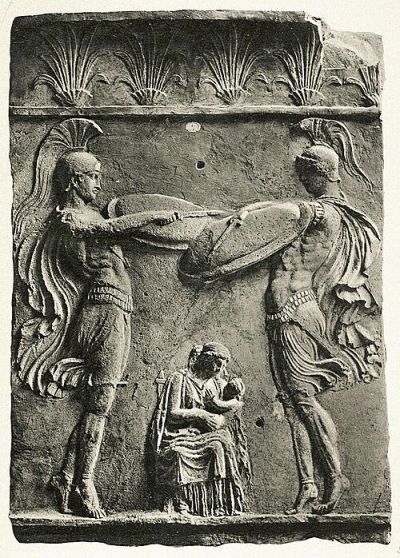
Image: Amalthea holds the young Zeus, behind two Kouretes carrying swords and shields. Campana relief from the late 1st century BC or early 1st century AD, Ny Carlsberg Glyptotek.
ZEUS, THE BEES & THE CURETES
If we follow the bee back into Crete, things get considerably stranger.
The infant Zeus is hidden in a sacred Cretan cave and, in different versions of the myth, nourished by bees, by the nymphs Ida and Adrasteia, or by a combination of honey and milk. The bees themselves are described as the nurses of Zeus. In another Cretan story, the child Meliteus, son of Zeus and the nymph Othreis, is likewise fed by bees.
But the bees are not the only creatures surrounding the birth of Zeus.
The Curetes are the armed guardians who attend the divine birth, dancing and clashing their weapons so that the infant's cries cannot be heard. Their own birth is remarkable: they sprout from the mountainside after a great rainfall, appearing almost like primordial organisms emerging from the earth.
The mushroom is perhaps the most obvious image of this kind of emergence. It appears after the rain, seemingly from nowhere, while its greater body remains hidden beneath the earth. The Curetes become almost mushroom-like figures themselves: beings that sprout from the earth at the arrival of the generative waters.
So why would the mushroom need to be occulted at all?
The bee works in a similar way. It gathers something invisible to us from flowers and transforms it into honey. It moves between flower and hive, wilderness and cultivated order, earth and heaven.
Zeus seems to stand at the center of that ordering principle.
Even his more chthonic manifestations complicate the picture. Zeus Ktesios, guardian of the household's stored abundance, could appear in serpent form. Zeus Meilichios, the “kindly” or “gracious” one, was associated with a great underground serpent and received honey offerings. Serpents belonged naturally to the underworld because they disappeared into the earth and returned from it, making them fitting symbols of a mystery concerned with what lies beneath the visible world.
And honey was not reserved exclusively for the dead or the underworld. It could also be offered to upperworld divinities, including Helios, Mnemosyne and the Muses, nymphs, Pan, Priapus, Selene and Aphrodite Urania.
Rain falls from heaven. The earth receives it. Something emerges. The bee gathers from the flowering earth and transforms it. The serpent disappears beneath it. The mushroom rises from what was hidden.
And Zeus, born in the cave and raised on honey, sits strangely in the middle of all of it: celestial ruler, rain-bringer, keeper of order, and in certain forms, an underground serpent.
Perhaps this is part of why the old mysteries speak so indirectly. The symbol is doing more than one thing at once.
NECTAR OF THE GODS
Hebe, daughter of Zeus and Hera and goddess of youth, was the cupbearer of the gods before her marriage to the deified Heracles. Ganymede, a mortal youth carried to Olympus by Zeus, eventually assumes the role.
His later identification with Aquarius makes this especially intriguing. Aquarius is usually imagined as a water-bearer, but Ganymede's original function was not simply to pour water. He poured nectar, the divine drink associated with immortality. The image can therefore be understood as an endless celestial libation, the continual transmission of a life-giving substance from heaven into the world.
This raises a larger question: what was the nature of the divine substance being prepared, carried, and consumed?
The Melissae were associated in ancient tradition with priestesses and initiates of Demeter and Persephone. The bee itself is an extraordinary image of transformation: it gathers floral nectar and transforms it into honey. Demeter's agricultural domain likewise concerns transformation; seed into plant, plant into grain, grain into nourishment.
Honey was not merely a sweetener. It was medicinal, preservative, intoxicating in some circumstances, and deeply embedded in ancient religious symbolism. Certain honeys, such as “mad honey” produced from rhododendron nectar, can contain psychoactive grayanotoxins and produce profound physiological effects.
The same boundary appears in the mystery traditions through the kykeion, the ritual drink of the Eleusinian Mysteries. Its known ingredients do not establish a mushroom preparation, and the surviving evidence does not give us a secret Eleusinian recipe, we do know that ergot, a psychoactive fungus, was in the mix. The persistent language of nectar, ambrosia, honey, medicine, nourishment, initiation, and immortality suggests transformative substances.
Ancient Mediterranean traditions associated fungi with thunder and lightning. Plutarch even discusses the belief that mushrooms were generated by thunder. This is particularly suggestive in relation to Zeus, whose defining atmospheric force is the thunderbolt. The mushroom becomes an extraordinary image of transformation: something hidden beneath or within the earth suddenly produces a visible fruiting body.
MILK & HONEY
We talk about milk, honey, wine and rain as though they were simply ingredients in ancient ritual. They were not interchangeable.
In Greek ritual, milk and honey have a particularly strong relationship with the dead and with the powers beneath the earth. When Odysseus calls up the dead, the first libation he pours is milk mixed with honey, followed by wine and then water. The mixture itself has a name: melikraton.
And then there is another preparation whose name is almost embarrassingly literal: hydromel.
Hydromeli means water-honey, honey dissolved in water. The earliest form is not necessarily the wine-like mead we imagine today. Ancient medical and agricultural writers describe preparations of honey and water, sometimes using rainwater, some of which were allowed to mature or ferment until they acquired the character of wine.
Image: Goddess as Queen Bee - Artemis of Ephesus.
There is also oinomeli, wine mixed with honey.
These ritual liquids begin to look like variations on a very old vocabulary of water, nourishment, transformation, descent, fermentation, preservation, death and emergence.
Wine introduces another layer. Wine itself is already transformed matter: fruit, crushed and fermented into something that changes the consciousness of the person who drinks it. Honey can be added to wine, and ancient medical and ritual literature preserves numerous honeyed preparations.
Even rainfall was not merely water falling from the sky. It could be understood as the seminal fluid of heaven, the milk of the celestial herd, or the sexual emission of the god. Rain was the generative substance that descended from above to fertilize the earth below.
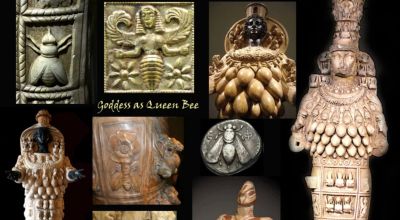
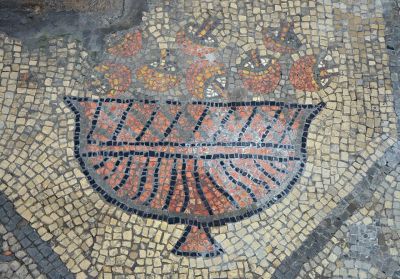
Image: A detailed section of an early 4th-century AD mosaic floor depicting a basket of mushrooms, located in the Theodorian transversal hall of the Basilica di Santa Maria Assunta in Aquileia, Italy.
MYCENAE & THE MUSHROOM
There is another extraordinary story buried in the mythology of Perseus and the founding of Mycenae.
Perseus, returning to Argos after fulfilling the prophecy of Acrisius, stopped to rest and became thirsty. In one version of the story, he picked a mushroom from the ground and drank the water that had collected in it. He was so pleased with the spring that emerged from the mushroom that he named the place Mycenae.
There is no simple, ordinary English word for mushroom that carries this ancient mystery. The word itself is comparatively late, derived through French mousseron from Latin mussare, “to murmur” or “mutter,” and ultimately associated with the Greek mukaesthai, “to bellow.”
The mushroom, in other words, carries a history of sound in its name.
Mustērion. Mustēs. Mystery. Initiate.
The same mu syllable sits at their beginning. In the Mycenaean syllabary, the sign associated with this sound was represented by a bull's head.
The bull. The mushroom. The mystery. The initiate.
And the very sound of mu, the lips closed, the sound contained within the mouth, evokes something that cannot be spoken.
Mum's the word.
A secret kept behind closed lips.
WTF IS BUGONIA?
There is perhaps no more extraordinary image in the ancient Mediterranean for the mystery of regeneration than bugonia, the generation of bees from the carcass of a bull.
The word itself tells the story: bous, the ox or bull, and gonē, generation or birth. The bull dies, its body enters into putrefaction, and from that death there emerges a swarm of bees.
This is not simply an oddity of ancient natural history. It belongs to a much larger complex of imagery in which death becomes the precondition for transformation.
The bull is already a creature of extraordinary generative potency. It grazes upon the vegetation of the earth and converts the abundance of the pasture into its own living body. In sacrifice, that body is returned through blood, flesh and offering. In bugonia, the dead bull becomes something stranger still: its decomposing body gives rise to the bee, whose honey is sweetness.
The apparent contradiction is precisely the point.
Virgil places his account of bugonia in the fourth Georgic, within his larger meditation upon agriculture, animal husbandry, bees and the mysterious ordering of nature. The procedure is presented as Egyptian, suggesting that the Roman poet was already receiving the image as something belonging to an older antiquity.
And here we should resist the temptation to dismiss the story simply because bees do not literally arise from dead cattle.
BULL ABOVE. BULL BELOW?
Grazing animals create an environment absolutely alive with biological activity. Their dung becomes food and habitat for insects, microorganisms and fungi. Certain mushrooms, including dung-loving species of Psilocybe, are intimately associated with herbivore manure.
Add rain, moisture, warmth, grazing and seasonal change, and suddenly the pasture becomes a laboratory of emergence.
There is another piece of the puzzle here: the Pleiades.
Their heliacal appearances and disappearances were important seasonal markers for ancient agricultural and pastoral communities, helping mark changes in the agricultural year, including planting, harvest, navigation and herding. In the celestial landscape of Taurus, the Pleiades sit upon the shoulder of the Bull.
They can be described as lying along the Bull's leg, a correspondence that becomes particularly interesting when the shape of the cluster is considered alongside the form of a mushroom.
(Watch Ryan Seven’s video demystifying Bugonia here.)
The Pleiades have also been associated with bees in various mythological and astronomical traditions. The Greek melissai, literally “bees,” appear in traditions surrounding nymphs, priestesses, prophecy, nourishment and mystery.
Now place the celestial Bull above the actual cattle landscape below: the bull grazing, producing dung, insects gathering, fungi colonizing, rain entering the earth and mushrooms appearing from what was previously hidden.
Above them, the Pleiades mark the seasonal cycle within the body of Taurus.
Below them, cattle participate in another cycle of transformation.
THE LION & THE BEE
If the Bull takes us into the wet, fertile world of cattle, dung, fungi, rain and the returning Pleiades, the Lion brings us into the heat of summer.
The connection becomes especially interesting in the Mithraic mysteries. The Lion was the fourth grade of initiation and was associated with fire. Porphyry tells us that honey was poured over the hands of the Lions instead of water, and that honey was also used upon the tongue. Water was considered hostile to the fiery nature of the Lion, while honey was considered appropriate to the rite.
There are also actual images connecting the Lion and the bee. Mithraic monuments sometimes place a bee in the mouth of the Lion, while an inscription from Steklen records a Mithraic Leo named Melichrisus, a name meaning something like “honey-golden” or “honey-sweet.”
Honey was very much a product of the warm season. Pliny describes a distinct summer honey gathered during the period following the summer solstice, while thyme and other important bee plants were flowering.
Aristotle gives us something even stranger. He says that honey was believed to come from the air and connects its appearance with the risings of the stars. He also says that, as a general rule, there was no honey before the rising of the Pleiades.
Ancient people were watching the sky and the hive together.
This is where the image of the Lion consuming the Bee becomes particularly interesting.
Could the Lion consuming the Bee be another way of representing the seasonal disappearance of the Pleiades?
The bee belongs to the Pleiades in the mythological associations we have been tracing. The Lion belongs to the height of the solar year. As the Sun moves through the region of Leo, the Pleiades are near the Sun from our perspective and disappear into the daylight.
The Bee has been swallowed by the Lion.
Then, after its period of invisibility, it returns before dawn.
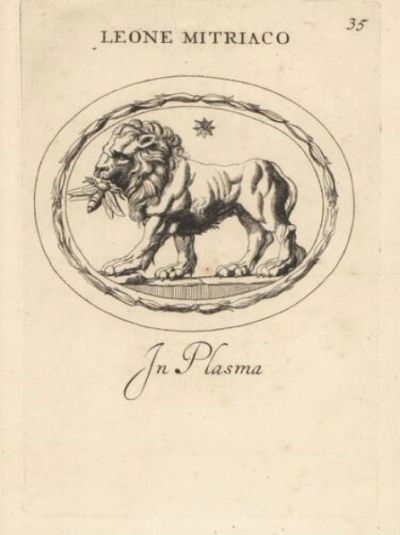
Image: Dionysos, Satyr, Bacchante.
THE HONEYED ONE
This is where Porphyry becomes particularly important.
In On the Cave of the Nymphs, Porphyry is discussing an ancient cosmology of souls, generation, water, caves and the descent into embodied life. In the middle of this discussion he gives us something remarkable.
The priestesses of Demeter were called Melissai, bees. Persephone herself was called Melitodes, the Honeyed One.
Porphyry then tells us that the Moon, which presides over generation, was also called a bee and a bull. Taurus was the Moon's exaltation.
And then comes the line that really catches us:
Bees are born from oxen.
Whatever layers of earlier tradition Porphyry has compressed together here, the associations are explicit.
Demeter's initiates are bees. Persephone is honeyed. The Moon is bee and bull. Bees are ox-born. And suddenly our Bull is back.
We have already encountered bugonia, the generation of bees from the carcass of an ox. But Porphyry places that idea directly beside the Moon, generation, Persephone, Demeter and the souls entering material existence.
That matters when we turn to the Mysteries.
The Eleusinian Mysteries belonged to Demeter and Persephone, and their central ritual experience was deliberately concealed from outsiders. The initiates fasted, drank the kykeon and underwent rites whose final revelation was never openly described.
Ancient mystery traditions preserve memories of relationships with visionary plants and fungi. Dionysus is especially important here because he is not merely the god of wine. Dionysian traditions preserve an older world of wild intoxicants, mushrooms, herbs and plants gathered outside the cultivated agricultural landscape.
And then there is the thyrsus.
We tend to see it simply as the familiar Dionysian wand, a fennel stalk wrapped in ivy and topped with a pinecone. But there is another layer. The thyrsus was associated with the narthex, the hollow stalk that could function as a container for gathered plants. More strangely, thyrsus also occurs in ancient terminology connected with the stem or stalk of a mushroom.
The image gets wonderfully strange.
The mountain woman goes into the wild carrying the thyrsus, the gatherer's container. The wild plants go into the container. Above that stalk sits the cap.
Dionysian ritual takes us somewhere Demeter's Mysteries cannot quite take us openly: into the mountains.
The Bacchae repeatedly places Dionysian worship outside the cultivated city, on the mountain, where the thiasos follows the god into wild country.
And this brings us back to the mushroom.
A mushroom is not cultivated like grain. It appears where conditions have assembled themselves: moisture, substrate, season, decay and hidden fungal growth. You go looking for it. You forage it. You find it emerging from a landscape that has been quietly preparing it.
That is a very different relationship from planting a seed and watching a crop grow. This is the juxtaposition of the forager vs the cultivator. Perhaps this helps explain why the Demeter and Dionysus traditions can feel so different while sharing such deep subterranean imagery.
Demeter gives us grain, the cultivated field, the seed, the harvest and the hidden return of life beneath the earth.
Dionysus gives us the wild mountain, the gathered plant, fermentation, ecstasy and the sudden appearance of what was already alive but hidden.
And somewhere between them is the mushroom.
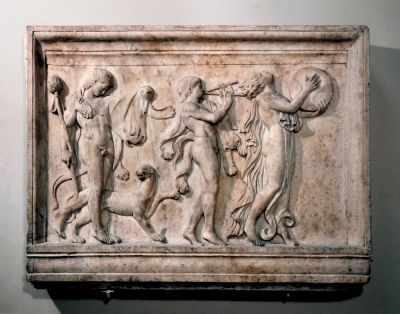
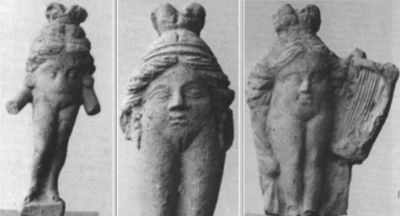
Image: Terracotta Baubo figurines from the Demeter sanctuary at Priene. Found in 1898.
BAUBO, THE VULVA, & THE MUSHROOM
If Demeter's story is concerned with the loss of Persephone, the barrenness of the earth and the eventual return of life, Baubo enters the story in a decidedly stranger way. She is the obscene old woman, the grotesque little figure who exposes herself to the grieving goddess and makes her laugh. But the obscenity is not incidental. It is the mechanism of the myth.
Baubo is not simply a comic character with an obscene gesture. She is an anthropomorphism of the female sexual organ itself, with the belly becoming a womb and the exposed vulva functioning as an opening into the hidden interior of the body. In one version of the imagery, Demeter is shown what is concealed inside that opening: a child.
This is where the mushroom begins to enter the picture.
Iambe-Baubo can be placed among a class of dwarfish grotesqueries described as fungal anthropomorphisms. These strange beings have exaggerated feet that function like parasols, and their movements imitate the sudden bursting of mushrooms from the ground. The mushroom is small, squat, concealed and then suddenly present, its cap appearing above the earth as though something has pushed its way out from below.
Baubo's exposed body is therefore more than sexual comedy. It is an image of revelation through an opening. The vulva itself is a gateway and connects this imagery with the doorway of the central shrine at Eleusis, where the birth of the Mystery Child was proclaimed. The initiate's movement through the sanctuary consequently mirrors the same movement: entering the hidden realm and emerging again through the symbolic birth passage.
This gives us another possible way of looking at the mushroom.
And then there is the question of fluid.
Ancient fertility symbolism repeatedly refuses to separate sexual generation from the generative processes of the natural world. Semen, menstrual blood, milk, rain, sap and the fluids of the earth can all become metaphors for transmission, nourishment and creation. There is, as example, the blood of Medusa becoming coral and the spongy, water-absorbing coral as another metaphor for the mushroom's relationship with rainfall.
This is particularly interesting when placed beside the ecology of mushrooms.
The mushroom does not appear simply because a mushroom exists. Something has happened beneath the surface first. Mycelium has occupied its substrate. Moisture changes. Temperature changes. The conditions become right, and suddenly the fruiting body appears with rain, like semen, to the earthen womb.
MAGICKAL TEXTS
And then we come back to honey.
Honey appears throughout the Greek Magical Papyri as a ritual and medicinal substance. It is used in mixtures with milk, wine, oils, herbs and other materia. Honey also appears extensively in Egyptian medical literature.
This matters because honey was not simply valued for its sweetness. Its low available water and acidity inhibit microbial growth, making it an effective natural preservative under the right conditions.
Put a mushroom into that context and the practice of preserving fungi in honey becomes much less strange.
The mushroom has a short visible life. Harvest is therefore critical. The fruiting body appears only when the environmental conditions are right: moisture, temperature, substrate, season and the activity of the organism beneath the ground. Once harvested, the goal is to retain what has appeared at that particular moment.
This becomes particularly relevant with psychoactive mushrooms, whose active compounds can vary considerably between species, specimens and growing conditions. Preservation is therefore not merely about keeping the mushroom from spoiling. It is about retaining what the mushroom has accumulated during its period of fruiting.
Honey provides a remarkably stable medium for that kind of preservation.
And there is another history here that is difficult to ignore.
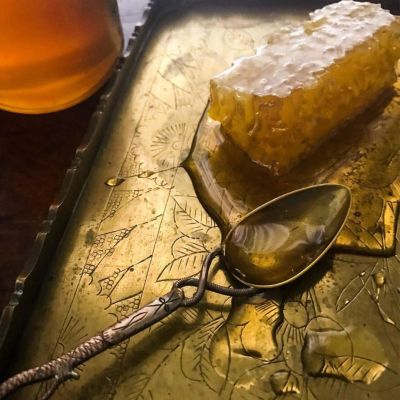
Image: Human bones on the floor of the Ananauri 3 burial chamber. Scientists found them coated with the tell-tale remnants of honey—pollen and bee fragments.
MELLIFICATION
There is another strange dimension to honey: mellification, the reported preservation of bodies and medicinal substances in honey.
The idea has a long history. Herodotus describes the Assyrians embalming their dead with honey, and later traditions claimed that the body of Alexander the Great was transported in a honey-filled vessel.
The most extraordinary account appears in the Chinese medical tradition. In the Bencao Gangmu, the great sixteenth-century pharmacologist Li Shizhen records a story attributed to the earlier Yuan-dynasty scholar Tao Zongyi: elderly men in Arabia supposedly volunteered to consume almost nothing but honey before death, after which their bodies were immersed in honey for a hundred years. The resulting substance, called miren (蜜人), or “honey person,” was said to be taken medicinally for wounds and broken bones.
At the Bronze Age Ananauri 3 burial in Georgia, archaeologists recovered berries approximately 4,300 years old that had been preserved in ancient honey. Human remains from the burial also bore pollen and fragments of bees, interpreted as remnants of honey that had long since disappeared.
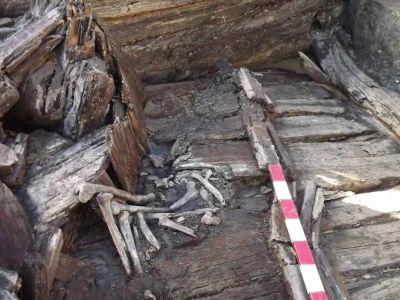
Image: Researchers at the University of Bristol detected chemical ‘fingerprints’ of beeswax at multiple Neolithic sites across Europe, including on ancient shards of pottery.
WHY THE EVIDENCE DISAPPEARS
This raises an important question: if honey, mushrooms, and transformative plant substances were part of ancient ritual practice, why don't we find more of them?
Part of the answer is that archaeology is exceptionally good at preserving some things and extraordinarily bad at preserving others.
Stone, ceramic, metal and bone can survive for thousands of years. A ritual beverage cannot. Honey is chemically complex organic material; mushrooms are soft-bodied fungi; plants, fermented liquids, resins and medicines can decay, evaporate, leach into soil, or be consumed completely. Even when a substance was deliberately placed inside a vessel, what remains thousands of years later may be only a chemically altered residue; or nothing recognizable at all.
Mushrooms are particularly difficult. A study specifically examining the “missing mushrooms” of archaeology notes that mushrooms are very rarely recovered from archaeological sites because they are soft-bodied organisms. The fungal remains that do survive are disproportionately durable forms such as bracket fungi and polypores. The authors point out that there is little tangible archaeological evidence for the edible mushrooms people were actually likely to have consumed.
Honey presents a different problem. It can survive remarkably well under the right conditions, but we usually do not excavate a jar of recognizable ancient honey. Archaeologists more often find its chemical fingerprints: beeswax compounds, pollen, sugars, proteins, or degradation products preserved in pottery, sediments or other materials. Researchers have developed increasingly sophisticated methods for identifying these traces precisely because the original substance is usually gone.
One example comes from a Greek sanctuary at Paestum, where bronze vessels excavated in the 1950s contained an ancient residue. The material had originally been interpreted as honey, but subsequent laboratory studies rejected that identification. In 2025, researchers returned to the residue using multiple modern techniques and detected saccharide degradation products, hexose sugars and, most significantly, proteins characteristic of honeybee secretions. The new evidence supports the presence of honey or honeycomb in the original ritual deposit.
The significance is larger than this single discovery. Even when an ancient ritual vessel survives, and even when its contents leave a residue, we can misidentify what was there for decades. Or simply not test for what is there at all.
And there are other examples of honey surviving in extraordinary circumstances. At Vani in Georgia, archaeologists identified honey saturated with pollen, bee hairs and other bee remains in a Classical-period funerary context, providing direct evidence for honey's use in burial practice. Archaeological research has also identified beeswax in pottery from prehistoric West Africa, demonstrating honey collection approximately 3,500 years ago through chemical residue analysis rather than preserved honey itself.
This is why the absence of a recognizable ancient “honey potion” is not necessarily evidence that such preparations did not exist. The archaeological record is not a record of everything people used; it is a record of what happened to survive, what happened to be excavated, and what modern science is capable of recognizing.
The problem becomes even greater when the proposed substance is a preparation rather than a raw material.
Imagine a ritual drink containing honey, wine, grain, herbs or fungi. The liquid is consumed. The vessel is washed or reused. Centuries later, the vessel may contain only an ambiguous organic residue. Even if traces remain, identifying the original recipe requires distinguishing among substances that can produce overlapping chemical signatures. The Paestum discovery demonstrates precisely how complicated this can be.
And mushrooms present an additional problem: we may not even know what archaeological absence looks like. Fungal spores can sometimes survive and can be detected through specialized analysis, but their presence does not automatically tell us whether a mushroom was eaten, cultivated, deposited ritually, or simply arrived naturally. Ancient fungal DNA is also rarely reported, and even when it survives, interpretation is difficult. Recent work on the Copper Age Iceman Ötzi, for example, has recovered ancient fungal DNA from his digestive tract—but the researchers interpret these fungi as likely accidental dietary associations rather than evidence of intentional mushroom consumption.
This is one reason the archaeology of ancient mushrooms remains such an open field. Researchers studying the cultural history of mushrooms in Greco-Roman antiquity note that the evidence is still sparse, with substantial gaps in the archaeological, textual and visual record. They specifically identify the detection of fungal spores and other archaeological methods as promising avenues for recovering evidence that would otherwise disappear.
And perhaps this is precisely why nectar and ambrosia remain so elusive. If they were ever more than mythic names for divine nourishment, they belonged to a class of substances that were prepared, consumed, transformed and ultimately destroyed in the act of being used.