WAS THERE AN ERATOSTHENES IN THE AMERICAS?
mat apocalypse - september 2026
More than 2000 years ago, circa 240 BCE, a Greek man named Eratosthenes accurately measured the circumference of the Earth using nothing more than the sun and a stick.
Okay, perhaps that was an over exaggeration, as Eratosthenes was armed with a vast knowledge of both geometry and astronomy. A true polymath, Eratosthenes studied and wrote on geography, mathematics, poetry, music theory and even studied various branches of philosophy, including stoicism under its very founder, Zeno.
Eratosthenes’ achievements were almost endless and encompass a multitude of disciplines. To list just a few, he was the first person to accurately measure the axial-tilt of the Earth in relation to the plane of the ecliptic, he was the first person to create a geographical projection system using parallels and meridians and he was the first person outside of ancient China to invent the armillary sphere, a tool that would be used by astronomers for nearly two-thousand years.
Despite his vast knowledge and incredible achievements, Eratosthenes was referred to as Beta by his critics. Many saw him as only the second best in his chosen fields of study, those who specialised in a single discipline were considered to be his academic superiors. However, it’s often the generalist that sees the bigger picture, then brings in new innovations, breaking new ground. Seeing as Eratosthenes was considered to be the second best at nearly everything, perhaps it would be unfair to call him a mere generalist.
Critics aside, there were those who appreciated Eratosthenes for both his vast knowledge and achievements, and these were people that really mattered. Born in 276 BCE in Cyrene, in what is now present day coastal Libya, Eratosthenes was born into the Ptolemaic kingdom. It was the Ptolemys who inherited the conquered lands of Alexander the Great after his death. As a young man, Eratosthenes moved to Athens to further his studies, where he stayed for approximately twenty years, before being summoned to Alexandria by Pharaoh Ptolemy III - Euergetes. Such was Eratosthenes’ reputation, Euergetes appointed him as chief librarian at the famous library of Alexandria. As chief librarian it was Eratosthenes’ responsibility to become royal tutor to Euergetes successor, his son, Ptolemy IV - Philopator. Eratosthenes was also affiliated with the great Ancient Greek inventor and engineer, Archimedes, who greatly appreciated Eratosthenes’ for his feedback and contributions to his own works and innovations.
Eratosthenes’ original methodology for calculating the circumference of our planet was documented in his work On the Measure of the Earth. Unfortunately, like the majority of the works formerly found at the library of Alexandria, most of Eratosthenes original work has since been lost to history. Over it’s five-hundred years, the library of Alexandria burned down multiple times, each time more of it’s contents were destroyed. The first and most famous conflagration occurred circa two-hundred years after it’s construction, in 48 BCE, during Julius Caesar’s civil war, though it should be noted that this was more of a case of collateral damage as opposed to arson. What was left of the library of Alexandria was likely destroyed during the Palmyrene invasion circa 270 CE. The library was already lacking support during the Roman period, hence there was no will to rebuild the archives after its final destruction. Copies of some of it’s works lived on in the Serapeum temple at Alexandria which, amongst other functions, served as a daughter library. Unfortunately in 391 CE, Bishop Theophilus of Alexandria, in his quest to suppress paganism, ordered that the Serapeum and it’s contents be destroyed.
Fortunately for us, there is a second hand account of Eratosthenes’ technique for measuring the size of the Earth in Cleomedes’ work On the Circular Motions of the Celestial Bodies. Unlike Eratosthenes, Cleomedes was not a polymath, however he was an established and accomplished astronomer. It’s difficult to place Cleomedes chronologically, he was born some time between about 50 BCE and 400 CE, but the important point to note is that he would have been alive at a time when he would have been able to access the work of Eratosthenes. Cleomedes provides us with a simplified version of Eratosthenes experiment and for good reason, when dealing with spherical geometry and moving celestial bodies it can be difficult to visualise what is actually happening. By simplifying the explanation, Cleomedes gets the point across clearly to both the novice and the layman, unfortunately this has lead to a misunderstanding where modern scholars accuse Eratosthenes of getting lucky with his measurements and methods. It seems that even more than two millennia after his death, Eratosthenes still can’t shake his critics.
By the time Eratosthenes was born, it was already well known that the Earth was spherical. Pythagoras reasoned that if the moon was spherical, then so must the Earth be, his justification came from analysing the shape of the boundary between light and dark on the lunar surface. Anaxagoras took this a step further, by analysing the shape of Earth’s shadow cast upon the moon during a lunar eclipse. Aristotle reasoned that the Earth must be spherical as the visible stars in the sky changed the further you travelled from the equator. Knowing that the world was spherical, Eratosthenes reasoned that you could measure the arc angle between any two points on the Earth’s surface, then measure the distance between them. The Earth’s circumference could then be inferred by multiplying the measured distance by how many times the arc angle fit into a full circle.
In 240 BCE, the Tropic of Cancer passed through the ancient Egyptian settlement of Syene, known today as Aswan. Knowing this fact, Eratosthenes chose this as his first reference point on the Earth’s surface, the second reference point was to be his adopted home city of Alexandria. On the summer solstice, Eratosthenes knew that no shadows would be cast at Syene during solar culmination or high-noon, as the sun would be directly overhead or perpendicular to the Earth’s surface (zenith). Eratosthenes then simultaneously measured the angle of the shadow cast by a gnomon, a stick terminated by a sharp point, at Alexandria. Eratosthenes made a measurement of 7.2 degrees. Eratosthenes now needed to measuring the distance between the two cities, to do this he employed professional bematists.
Back in the ancient lands of Egypt, Greece and Rome, bematists were employed to accurately measure the distance between towns, cities and landmarks. Early bematists were trained to walk with a consistent and even gait. Knowing the length of their own gait, they would count the steps from point A to point B, then multiply them by the gait length to arrive at a distance with surprising accuracy. By the time of Eratosthenes, bematists had moved beyond mere accuracy, distances were now measured with precision. We know from the work of Roman engineer, Vitruvius in his De Architectura, that the bematists of his time were using geared carriages to measure vast distances with precision, the geared mechanism would drop a small stone or pebble at fixed intervals. Although Vitruvius thrived approximately two-hundred years after Eratosthenes, we can infer from the precision of survey results, that the bematists of Eratosthenes era were likely using mechanical odometers of some sort.
The survey conducted by the bematists hired by Eratosthenes showed that the distance between Syene and Alexandria was five-thousand stadia. Eratosthenes calculated the size of the Earth thus:
(360°/7.2°) x 5000 = 250,000 stadia
This equates to 40,338 km or 25,065 miles in units that we’re familiar with today. The World Geological Survey 1984 (WGS84) geoid of the Earth gives us a polar circumference of 40,007.863 km or 24,859.734 miles and an equatorial circumference of 40,075.017 km or 24,901.461 miles. This shows us that Eratosthenes value for the circumference of the Earth is less than one percent out from our modern surveys, an astonishing achievement given the simplicity of the tools used in Eratosthenes experiment.
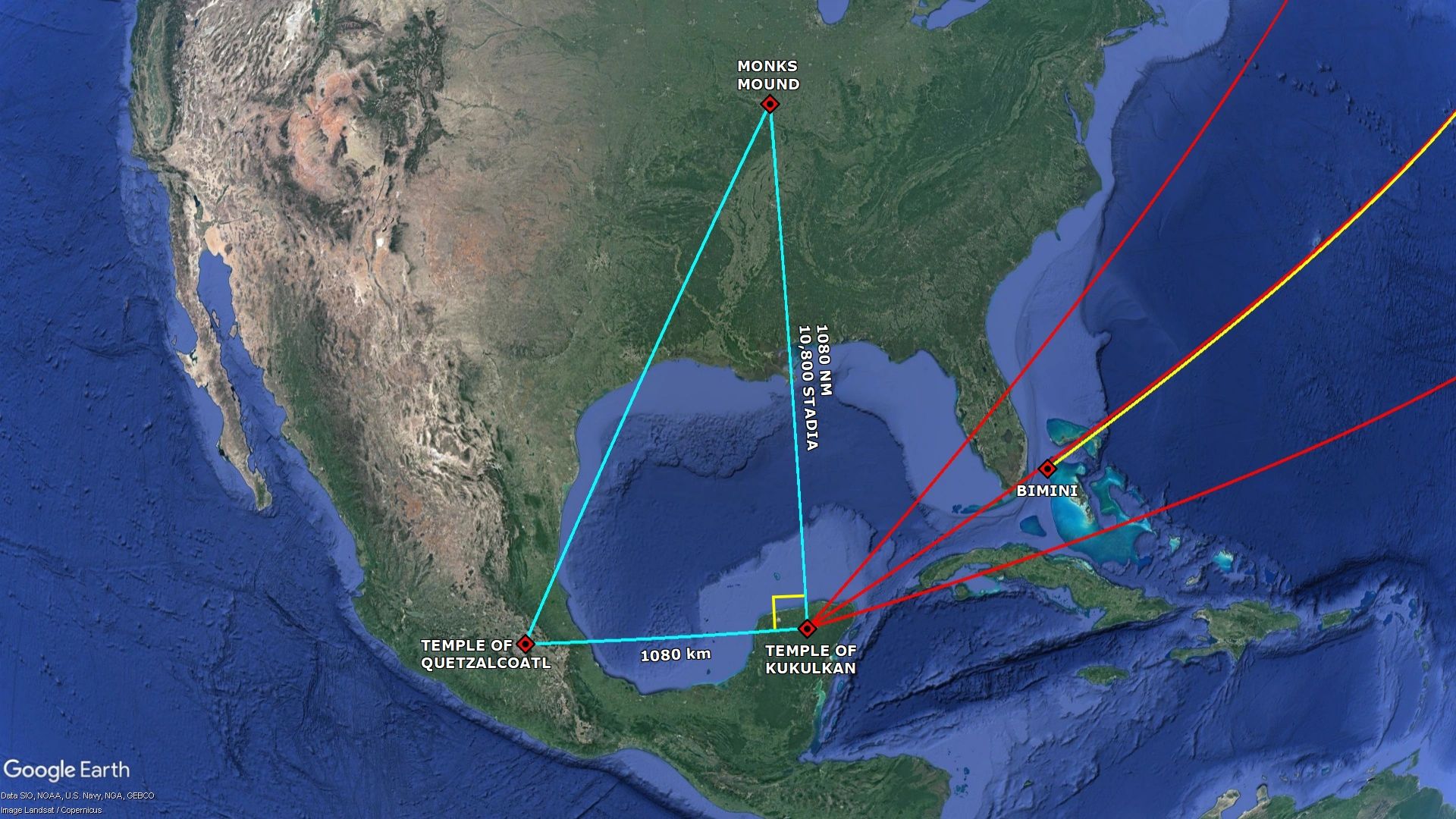
As far as we know, there was no contact between the Hellenic people of antiquity and the people of the Americas. However, there are monuments in the new world that suggest a similar experiment took place. The first clue is the temple of Kukulcan located in Chichen Itza, Meso-America. The temple is a four-sided step pyramid with 91 steps on each side with a temple at the apex. The 91 steps suggests that the builders were tracking the seasons as there are 91 days in each season (to the nearest whole number). The east face of the pyramid is aligned to sunrise on the day of zenith, the west face is aligned to sunset on the same day. Chichen Itza is located within the tropics, meaning that there will be two days per year where the sun will be at zenith above the temple of Kukulcan at culmination. Eratosthenes used the zenith above Syene as the zero point for his arc measurement and it looks like the same thing took place at Chichen Itza.
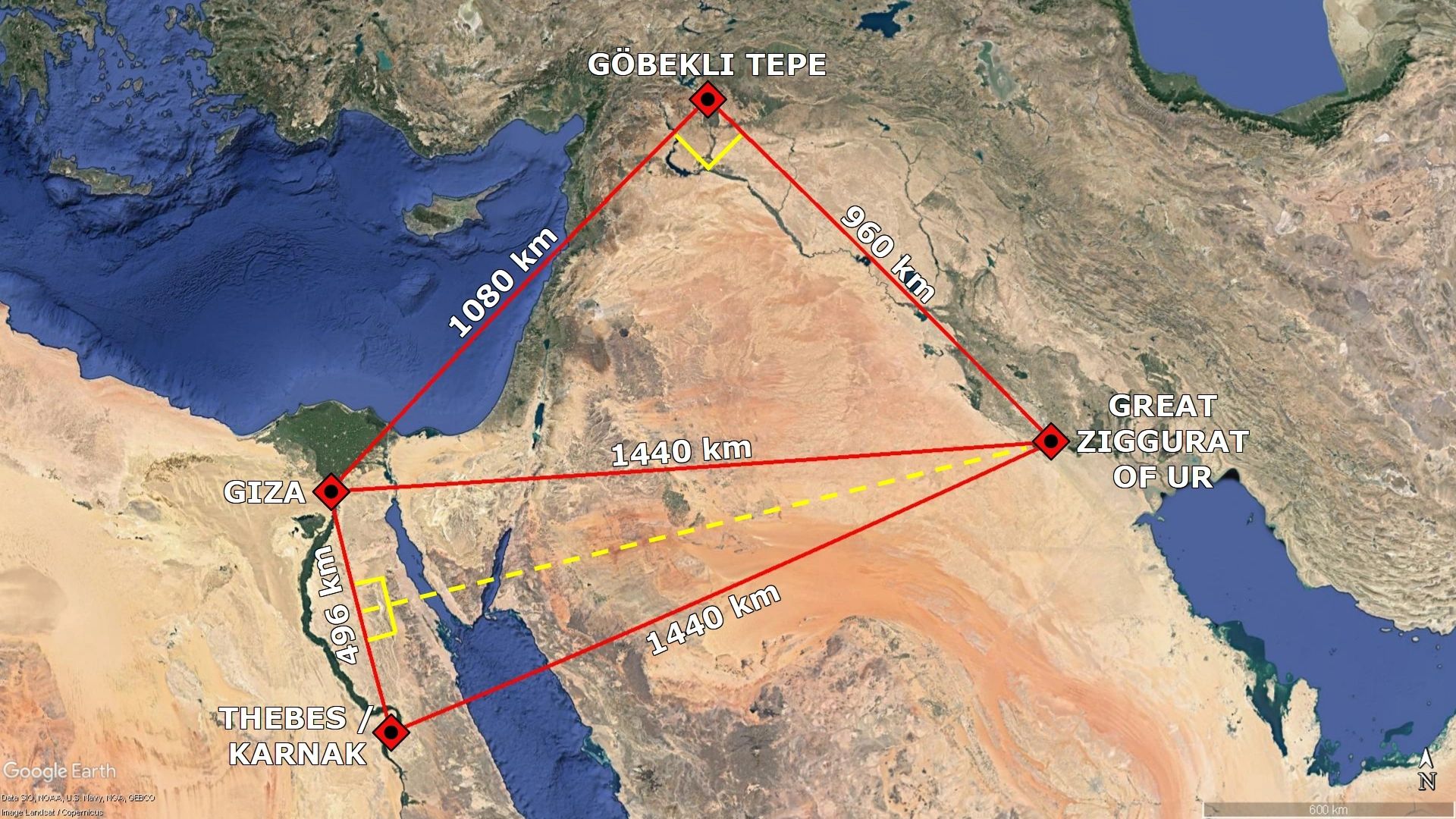
Our second clue is the temple of Quetzalcoatl at Teotihuacan, also in Meso-America. Quetzalcoatl and Kukulcan, although words used by two different peoples, the Aztecs and the Maya, both mean the same thing, the feathered or plumed serpent, a deity worshipped all over Meso-America. Remarkably, both temples are separated by a distance of 1080 km. The number 1080 is part of a cannon of numbers deemed sacred by various religions all around the world, these numbers were brought to prominence in the modern west by the likes of John Neal, John Michel and their peers. This cannon of numbers includes 72, 108, 144, 216, 360, 432, 540, 864 and multiples of. Similarly in the old world we can see that the head of the Sphinx at Giza is 1080 km from Gobekli Tepe (Gary Osborn). For anyone familiar with the work of people like John Neal, John Michel and Alexander Thom, you’ll understand that all units of measurement are based on the proportions of our planet; Earth measures. The Temple of Quetzalcoatl is also 2,160,000 inches away from the pyramid at Cuicuilco, further evidence that this cannon of numbers was being used in Meso-America.
The kilometre was originally defined as being one ten-thousandth of the distance between the Equator and the North Pole, if this 1080 km distance between the two serpent temples is proof that the Meso-Americans were familiar with the metric system, it begs the question: was this system communicated across time, oceans and cultures, or was it derived independently from experiments that followed the same logical sequence?
If we go back to Chichen Itza, we see evidence that the people of the Americas were familiar with the nautical mile. The nautical mile is defined as one minute of arc of Earth’s circumference (1/60 of a degree). This means that the Earth has a circumference of 21,600 nautical miles. The temple of Kukulcan just so happens to be 1080 nautical miles away from Monks Mound in North America. Remarkably, the bearing from both Quetzalcoatl and Monks Mound when observed from the zenith location (Kukulcan) forms a perfect right-angle. If you look into the works of Howard Crowhurst or the Heath brothers, you’ll see that most of the builders and architects in prehistory laid out their temple complexes using right-angled geometry (triangles, squares, rectangles). It should also be noted that the Maya used a base-twenty number system (vigesimal), this is important as 1080 nautical miles is 1/20 of Earth’s circumference.
The sites in the Americas are separated by time, they’re not all contemporary, suggesting that either this is all an astronomical coincidence, or that the present temples and earthworks are just the latest iteration of something that came before. Similarly there are sites in the old world that are seperated by the same measures, the same cannon of numbers and planned using right-angles. Again these sites are cross cultural and separated by time, however they predate Eratosthenes by thousands of years. We then have to ask ourselves if Eratosthenes was really the first person to accurately measure the size of our planet?