DECODER PRIMER
RYAN SEVEN - SEPTEMBER 2026
The ancients kept their secrets in symbols; here are the keys to their understanding:
First spend time with the cipher, briefly observing its parts and the whole, noting anything comprehensible and comparing it to similar iconography used in similar ways. Then look for hidden things, suggestive shapes in negative spaces, secret numbers, anomalies in the depictions, obvious mistakes and underlying geometries. Once exhausted, return to the larger picture for clarification before descending once again into the detail. If no answer shows itself allow the information to ferment in the back of the mind, hoping that sooner or later the tiny Archimedes that bathes in the waters there will exclaim ‘eureka!’ without much calculation by conscious effort. This mode of auto-didactic tuition is the intention of the creators of magical symbols – they work by the use of the archetypal forms which are the language of consciousness itself.
The ancient philosophers were tricksters; their great works were cryptographies, encoded by an array of techniques intended to keep their knowledge from those that should not know, and to inspire great things in those that should – each distinguished by their energies and efforts. The paramount cryptogram is often the first encountered: the name.
ETYMOLOGY
‘Etymon’, “true sense, original meaning” + ‘logia’, “study of, a speaking of”.
We should not forget the power of a word, seen to be an attempt to encompass that which it describes, though always inevitably falling short of a total description, as is the inherent problem with all maps.
The ability to track the root meaning of words is one of the best tools with which to investigate mystery symbols, which are often given names intended to reveal something of the talisman’s true intention.
Occult:
1530s, “secret, not divulged,” from Latin occultus “hidden, concealed, secret,”; from PIE root *kel- “to cover, conceal, save”. Meaning “not apprehended by the mind, beyond the range of understanding” is from 1540s. The association with the supernatural sciences, magic, alchemy and astrology dates from 1630s.
In certain languages, the letters themselves are archetypal symbols which give them an inherent meaning; for example: the letter A, the first letter, was originally inverted from its current position and was the glyph for an ‘ox’, which has meanings associated with its status as “the singular of many” - the bull that leads the herd, the apex, the most expensive thing, the “the singular of many” - the bull that leads the herd, the apex, the most expensive thing, the strongest thing. Combinations of these signifiers, when used by those that understood, gave foundation to the meanings of particularly ‘sacred’ words.
Duality is already present within words - vowels are the ‘masculine’ power, which sound out the word; consonants imbue the ‘feminine’ form.
In those languages which do not have specific icons for numbers, A is the number 1, and so on. From this utility arises the possibility of encoding words with numbers; something exploited by the metaphysicians of the past, and misunderstood in the present.
GEMATRIA and ISOPSEPHY
The study of the numbers secreted within certain words is called Isopsephy, from ancient Greek meaning “equal counting”, though the ancient Hebrew term ‘gematria’ has become more popular, that word itself taken from ancient Greek geōmetriā “geometry”, itself meaning “Earth measure”. In the gematria process, the individual number/letters of a word are added together producing a new number. Words with similar number-counts are grouped together and treated as if they are ‘linked’ for purposes of divination.
For myself, this use is a corruption or distraction from the cypher’s proper use of encoding certain mathematical truths and calculations into ‘sacred’ words. The gnostic deity “Abraxas” is a heavily encoded god-name and a typical example of how important numbers are hidden: each letter signifying one of the seven planets and the sum total of its name equalling the number of days in the year:
Α = 1, Β = 2, Ρ/R = 100, Α = 1, Ξ/X = 60, Α = 1, Σ/S = 200, total = 365
For the ancient priesthood, such stacked meaning gave the occulted names their power; for ourselves, it is a way of revealing the hidden intention of a secret icon.
UNIVERSAL KNOWLEDGE
The ancient cosmic order forms the basis of the symbols used by the ‘ancient tradition’. Although one aim of this book is to show you the awe inspiring things found hidden in these strange sciences, another aim is to give you the keys to decode these things yourself and find more wonders; I did not invent this art, it can be for us all; though I know it never will be.
As we now know, the best symbols are self-extracting, based on the solid foundations of philosophy of number and geometry, so as to carry their function across space and time and survive disaster, as was intended. The planets and stars seemed to govern time, and so were natural and steadfast teachers. They taught initiates by their place in the orbital hierarchy; by the time they took to complete a cycle; by how hard they shone; and by their usefulness as orientation for sailors and shepherds and sorcerers.
The secrets of the secret science always refer to this same system of star-lore, used to encode the high-arts, we will see that by interrogating the symbols of the stars we will reveal their secrets. Of course the cultural view of the cosmos is dependent on location and time, yet there is little real difference between these systems; the following is a synthesis of the deeper understanding of the general principles...
Below: the underworld. At the centre: the Earth and its axial pole. Above: whirl the heavens.



MOON
The Moon is the feminine pole in its ideal form..
First of the ‘inner planets’, Luna, having high agency in the rhythms of life on Earth is the closest to our Earth realm on the ladder of gods. The Moon pulls the tides and urges the creatures by its 29 day cycle, life gestates by the tempo of its pulse. The spectrum of the Moon’s phases reveals or obscures the contents of the night by reflecting light from the unseen Sun – allowing access to a hidden world for the hunter and horny beast.
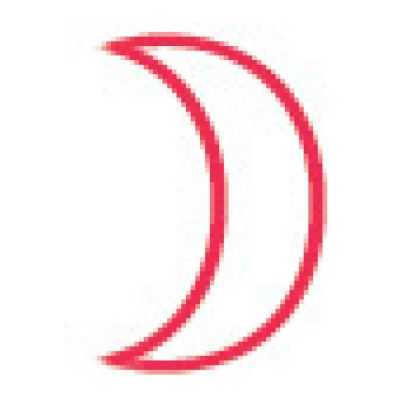
The properties of the Moon share much with elemental water, being that of a matrix, gestation and the other; it is the receptive, nurturing, feminine pole, which by its nature receives the active principle, the light of the Sun, and grows it through its lunar phasing; the New Moon in resonance with a semi-unconscious emptiness - waxing to a semi-conscious fullness at the Full Moon. The character of Luna is analogous to the mind, the spirit and the subconscious: all are mirrors and matrices which receive and form the light of the solar, conscious awareness; for this reason the magical symbol of the Moon is the same as the alchemical symbol for silver: a crescent moon; silver is the mother of mirrors.
The sphere of the moon acts as a lens for the spheres above it, their energies having to follow her laws in order to be born reasonably; in the same way all senses are received from the unconscious via the subconscious for examination by the conscious mind. This fact is utilised by mystics and psychologists, whom use the spectrum of ‘lunar’ mind-states to access the deepest parts of being available.
MERCURY
Mercury is the connective bridge between the two opposite poles., the synthesis.
Mercury is the swift planet with a short orbit of 88 days. As the closest planet to the Sun, it is never seen away from its patron, following it into the underworld at night, and like a less spectacular Venus, he heralds its resurrection in the morning. Due to Mercury’s frequent orbital reversals, and voyages beneath the horizon, as well as its synodic orbit being arithmetically compatible with all others - Mercury is deemed the messenger of the gods.
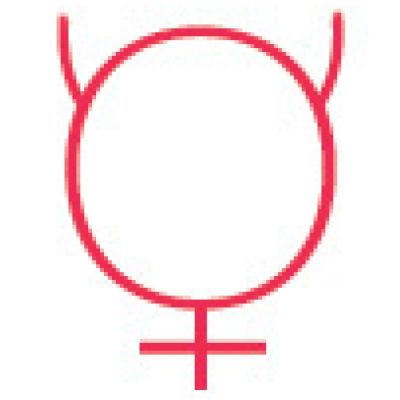
Mercury represents the centre-point between the feminine and masculine poles, the paradox of their combination; a bridging of opposites, a communication, an intercourse; in receiving the masculine energies it is feminine - in delivering the energies to the feminine, it is masculine. Mercury is analogous to the nervous system, conversation, and the intellect – all are rapid information delivery systems, which receive and transmit messages between the subject and the object; for this reason the magical symbol of Mercury is the same as the alchemical symbol for metallic mercury: a solar circle combined with a lunar crescent and an earth-cross, the only symbol to combine the three; metallic mercury dissolves both solar gold and lunar silver.
The properties of Mercury share much with elemental air, being that of a combination of fire and water: self and other in dynamic union, via a third party; herein lies the caveat. When dealing with the medium that is Mercury, Information might be lost in translation, or otherwise corrupted by the cunning manipulation of the messenger; thus Mercury is the god of symbols, guides, commerce, thieves and tricksters.
VENUS
Venus is the feminine pole during interaction with the masculine pole.
Venus is the opposite and complementary partner of Mars – each are intertwined and inter-dependent. Venus’ 225-day cycle is due to its position among the inner planets, which take less time than the Earth to make their cycles. Venus has little effect on the Earth, however within the features of its cycle it both precedes and proceeds the rising of the Sun, its reflected rays making it the third brightest object in our skies.
Venus’ shining beauty rises heavenward as if attempting to steal the throne of the Sun, only to be defeated and later cast downwards at the opposite end of its cycle. This aspiration gives Venus its name, meaning ‘desire’. From a geocentric view, Venus’ orbit makes golden-ratio infused pentagrams, a design shared by the living world. By another name, Venus is ‘Mother-Nature’.
Venus represents the receptive, feminine pole in symbiosis with the active, masculine pole; the two are inter-dependent and cannot be found without each other. Whereas the Sun and Moon represent the elementary polar-powers; when in combination and interaction they procreate complex, dense forms; as symbolised by the lovers, Mars and Venus.
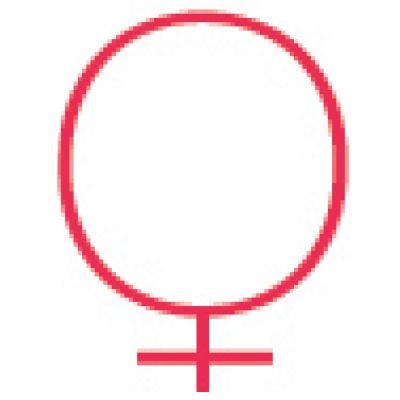
Venus is the nature of deficit and surplus within a “living” system; these are the causes of her natural drives. Desired objects are deemed “beautiful” according to the needs and appetites of Venus’ beholding eye. The magical symbol for Venus is the same symbol for “female” that we still use, mostly encountered due to the urge of certain natural desires for release.
The properties of Venus share much with elemental Earth, being that of a cycle of beginnings, middles and ends – something required, something attained, something assimilated. Never without the influence of her partner, Mars whom gifts Venus the capability of discernment; whereby her initial need can be refined into a true sense of beauty, beyond the compulsions of her natural appetites.
Venus is alchemically analogised with copper, which has a warm, aesthetic beauty, malleable, but yielding to the elements. A very conductive metal, copper absorbs heat, cold, electricity and magnetism equally readily.
SUN
The Sun is the masculine pole in its ideal form.
The Sun, Sol, has a special place in the cosmic order for we Earthlings, it is the orb which affects us most, its rays allow us to see, we warm ourselves by its daily and yearly cycles and feed ourselves on the results of its power – too little and we wither, too much and we wilt. The source of the Sun’s energy being from the Prime-Mover, the Sun’s corporeal role is something more of a lord, or a son of that original Monad.
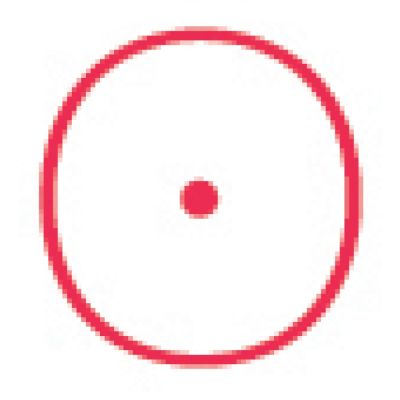
The Sun represents the active, masculine pole, for its energy-infusing properties. Its nature shines out from a central point, changing everything it touches – it is analogous to the identity, the soul and consciousness –all are as light shining from a central point; for this reason the magical symbol of the Sun is the same as the alchemical symbol for gold: circle with a point at the centre.
The properties of the sun shares much with elemental fire, being that of energy, creativity and the subject, the Sun’s power is a balancing capability, which is provided by the ‘light’ of the daytime-consciousness, which can redistribute energies in a thoughtful, rational fashion in order to grow.
The alchemical “solar-consciousness” is akin to gold: the purified metal does not tarnish, representative of the conscious state that is the aim of the sage.
MARS
Mars is the masculine pole during interaction with the feminine pole.
Mars is the opposite and complementary partner of Venus – the pairing describes the interplay of active and passive poles within a system, and are never found apart. Mars is the red planet, its blood-hues due to iron rust in the atmosphere; it has a 687 day solar-cycle and is the first of the three outer, less material spheres, yet it moves with much more pace than the other outer worlds.
Mars represents the active, masculine pole, engaged with the receptive, feminine pole; he is the fiery energy which powers a system, and because of his engagements with Venus, is aware of the struggle and sacrifice which must be made to divert his own energy into the feminine vessel, and so is symbolic of the willpower required to keep his integrity whilst sacrificing himself; for this he is the god of war and the spirit of battle. Mars is the wilful ‘no’ to Venus’ amenable ‘yes’.
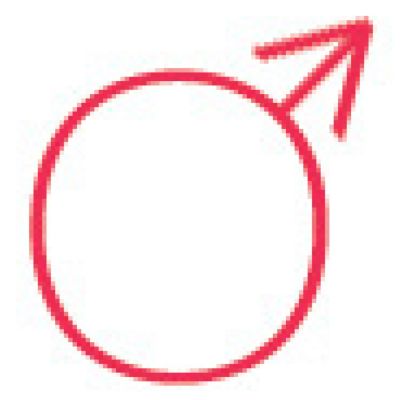
The magical symbol for Mars is the same symbol for “male” that we still use; its component parts form a shield and spear; in alchemy that symbol is Mars’ Iron, the metal of tools and weapons, which needs much fire, hard tempering, treating and sharpening to fulfil its extreme duty with merit, as does the man-at-arms, as does the ego.
JUPITER
Jupiter is the masculine pole in the presence of the feminine pole.
Jupiter is the opposite and complementary pole of Saturn – their child-and-parent relationship describes the interplay of order and chaos (hidden order) within a system, the child learning from the parent so that he might succeed him.
Jupiter is the penultimate of the planets, its twelve year solar-cycle corresponds to systems used on the Earth: the magician’s dozen of the zodiac, daylight hours, the inches of a foot, the pennies in a shilling of old money, twelve was the base for counting along with our ten fingers - both numbers associated with Jupiter, as all of these bring order. His twelve year cycle gives him rulership over the twelve deities of the zodiac, as well as his lording it over the planets.
Jupiter represents the active pole of the subject expanding - by re-ordering the receptive pole of the object: chaos into order. He is the matrix of reality energised into movement, the laws of physics in action and the resultant ‘way’ of the universe: our fate. Jupiter represents the higher cosmic order, inspiration, expansion, science and auguries – he is comprehension of the laws and the teacher of rules which circumvent the negative effects of reality.
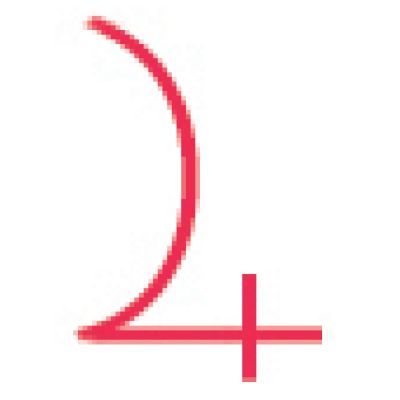
The magical symbol for Jupiter is the same as alchemists used for tin, a metal which shares characteristics of the other metals, it resists corrosion like gold, has mirrored finish like silver, alloyable like mercury, it is malleable like copper, and has utility like iron.
SATURN
Saturn is the feminine pole in the presence of the masculine pole.
Saturn is the contraction to Jupiter’s expansion, the first limitation.
Barely noticeable as separate from the background stars, save for Saturn’s slow orbit over 29.5 years, almost three times longer than Jupiter’s, making it the wizened old king - his understanding gained by his many years’ experience travelling through the degrees of the zodiac. Saturn’s position at the edge of the ancient cosmos has him corresponding with boundaries, the edge of the known: beyond is chaos – that which is unconscious.
Saturn represents the receptive pole that is the ‘other’ contracting the active pole of the ‘self’; it is the threshold that limits a set of objects into a common subject, resulting in a distinct ‘thing’ – ‘you’ are not ‘me’. Saturn represents the laws of physics, the contraction of eternity into time, materiality and mortality – he is the beginning and end.
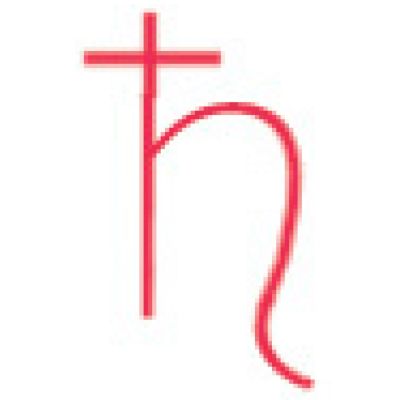
The magical symbol for Saturn is the same as alchemists used for lead, a heavy and poisonous metal, an element so dense, not even radiation can escape its structure; its low melting point makes it malleable, it is cheap due to its abundance and undesirable appearance; and yet it represented the starting material for the alchemist’s endeavour. Lead is to be made into gold, Saturn to become the Sun, the unconscious made conscious, the cycles of time - eternity.
THE STARS
Beyond the boundary of Saturn is the sphere of ‘fixed’ stars, its twinkling lights shining from the very edge of the universe. The angles of the earth spinning about the fixed stars were seen to be as a dial, each degree of movement changing the frequency of the energies broadcast onto the planets, thereby influencing their effects.
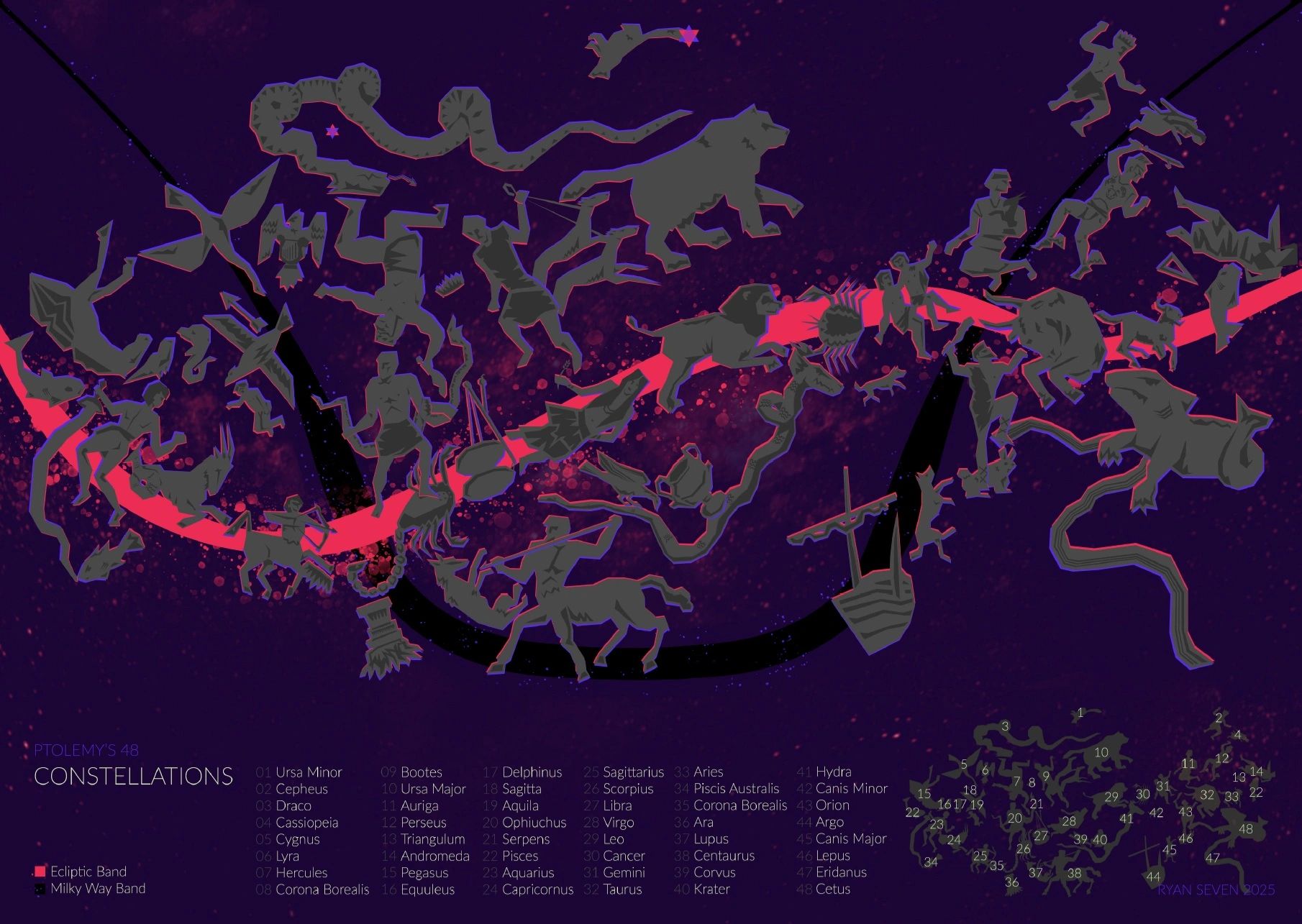
All of the stars are memes, most of their myths due to their usefulness in navigation, timing, and philosophical position. The stars become a calendar, a clock and a compass, shining alone or in constellations, the stars are a memory aid and a teaching tool. The secrets of the stars depend on their positions in one of three bands: the southern stars which lay mostly beneath the earth, the band of zodiacal stars which girdle the ecliptic, and the stars about the axis of the north-pole.
SOUTHERN STARS
Known for being mostly absent, the southernmost stars mapped by the ancients reach two-thirds of the way down the globe. Most notable is Centaurus, half-man, half horse, a great teacher whose myth has him portrayed as the mastermind whom mapped the epic of constellations around him, the hunting dog, the river of the dead, the huge vessel of the Argonauts... Additions attributed to later centuries of discovery include a disappointing bric-a-brac of an easel, a table, a triangle and a microscope.
THE ZODIAC
The zodiac is the backdrop to the path of the wandering stars: the planets - as they make their orbits around the solar system. The two paramount luminaries, the Sun and the Moon, were tracked by twelve divisions of the heavens, allowing for the counting of days and nights, a great boon to the hunter, gatherer, farmer and shaman – each aligning with the season to achieve their works. The stations of the zodiac are a symbolic calendar system, used to describe the flux of energies on the Earth dividended by the annual cycle of the heavenly bodies around their cosmic track. It was used as timekeeper of the year, the day and the lifetime.
The first sign Aries opens the agricultural year in late March, as it opens the day at 6am, dawn, as it opens the life of a person - all symbolised by the spring lamb. Opposite Aries are the scales of Libra, which close the agricultural year, when goods are exchanged and accounts are balanced, at 6pm it is the evening of the day and of the year - at this time of the equinox when day and night are in equilibrium. In the lifetime it is analogous to middle-age and time to take stock of the summer past.
The Zodiac is a library of ‘magical’ archetypes. Each of the twelve symbols has their character described by the fundamental of polarity. This irreducible concept of opposites: positive and negative, left and right, above and below - is used as a foundational element which is then intermixed with its opposite polarity according to its own inherent logic: as surely as day follows night, and between them are dusk and dawn.
Rather than using its common names, it is illustrative to see the zodiac as polarised charges: the top half is positively charged, the bottom half is negatively charged; likewise each sign as of Aries is positive, followed by negative Taurus, then bi-polar Gemini, and the pattern repeats. Each ‘charge’ is augmented by the polarities of the 4 elements and intermixed with the modality of the 3 modes: cardinal, fixed and mutable; or initiating, maintaining and changing “energies”.
Aries, for example, is an admixture of positive, fire and cardinal archetypes - creating a very energetic complex, describable symbolically as a “personality” that finds it easy to initiate projects, but soon burns itself out; much like the spring in the sleeping lamb.
The zodiac is an alchemical crucible of ratios and energies which encompass what we might encounter out in the world. Then, as now, the zodiac was a wheel of mind. As the planets stir up the energies of the soul, that is, our motivations - the Zodiac is seen to imprint its energies onto the spirit, which is the mind-matrix of individuality and experience.
Each planet is attributed two zodiac signs to rule over, and represent the two sides to each archetype, for example: the fires of Mars’ willpower burn in both the get-up-and-go energy of the infant Ram, and in the sexual urges represented in the adult Scorpion.
The Zodiac achieved its present form in Babylon, around 450bc, however the zodiacal constellations and their prototypes can be found in the Vedas a thousand years previous, at Gobekli Tepe nine-thousand years previous, and familiar constellations such as the bull of Taurus can be found on cave walls forty-thousand years into our deep past.
THE CIRCUMPOLAR STARS
The zodiacal, seasonal stars rise and set, live and die with the nightly procession, their journey’s arc beginning below the water’s edge at the end of the world, and on to the uppermost heavens; only to plunge back into the depths. Around the northern axis of the Earth spin the undying, circumpolar stars - which are close enough to the pole so as to never set in the northern hemisphere. The myths associated with these seven undying constellations were of particular symbolic and scientific importance to the stargazers of the past. The symbols of these stars denote the cosmic laws which although cyclical in their nature, always remain. Here we will look at two sets of the seven constellations:

URSA MAJOR and MINOR
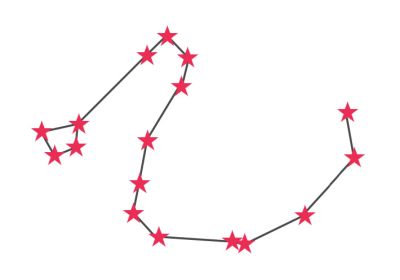
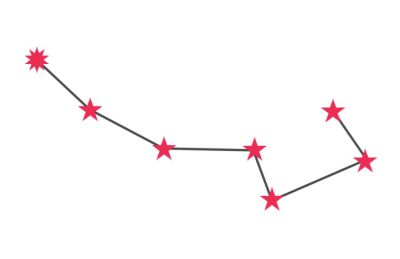
The central stars of Ursa Major form an asterism known to all since childhood, the ‘big dipper’; these seven stars have been part of star-myth since the childhood of man; when it represented a prey animal chased around the pole by hungry-bellied hunter-stars. The greater stars of the constellation Ursa Major, ‘Great Bear’ is mythologised as a huge female bear, and her cub in Ursa
The nymphess Callisto, devotee of the Moon, attracted Jupiter’s rapacious ardour; so he contrived to appear in the form of the goddess and seduce Callisto. The resulting pregnancy attracted the jealous ire of Jupiter’s wife. So as to evade Juno’s wrath, Jupiter transformed Callisto... Some years later the grown love-child, Arcas, had become a great hunter, and was met by his mother, whom shouted her greetings to him with open arms - terrified Arcas cowered in the shadow of a furious, great bear. As he raised his spear to slay the transformed beast, Jupiter intervened, averting the tragedy by casting the mother and child into the stars as the bears Ursa Major and Minor.
None are more ferocious than a female bear protecting its cubs; such intense guardianship can be turned against its dependent.
Callisto, meaning ‘beautiful, favourable’ – a desirable woman, fertile like the Moon, the feminine, subconscious, wild forces of nature. The bear symbolises the devouring aspect of the over-protective mother, and its cosmic and psychological correspondences: the uncontrollable aspects of nature, including the overwhelming contents of the unconscious, which when coupled with illusion, can lead to the destruction of our own creations, or indeed being destroyed by them.
The Ursa Major asterism of the “Big Dipper”, is also known as the “Wagon”, “Arthur’s Wain” in reference to King Arthur’s chariot, and the “Plough”. The seven stars of the Plough forms one of the oldest recorded and most widespread of magical symbols; the secrets of which are integral to these ancient mysteries.
DRACO
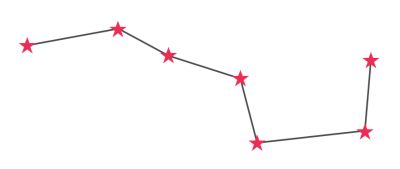
The monstrous deep-sea-serpent, Cetus, engendered monstrous offspring in the form of Draco, the “Dragon”.
As it is with all serpents, this dragon’s eyes never close, forever vigilant, never sleeping. Wrapping a half of its snaking coils around the top of the axial tree, the North-polestar, it writhes with the cycles of time. In previous epochs, its own stars had been pole-stars.
The monster takes several forms, under several names, Draco – “dragon, serpent, giant sea-fish”, originally meaning “to see, visible, clear, light” – this seeming dissonance likely stems from the mystery traditions, wherein the serpent is the premier symbol of the ‘wisdom’ - “to see, visible, to know”, and the ‘life-force’ itself. That knowledge, in the form of a tree which grows golden apples, is guarded by the dragon in the midst of the ‘garden of evening’.
Those who have this star rising will be snake charmers and prepare medicine from poisons and pigments of herbs. But if this star is found in its setting, they will die by the bite of poisonous snakes or from drinking poison.
- Firmicus Mathesis
The twilight of the ‘evening’, the ‘venomous’ snake, and the ‘poison’ all suggest altered states of consciousness. This dragon is not always speared for its treasure, sometimes being poisoned with another dragon’s blood - that of the Hydra; or is drugged with ‘poppy seeds and honey’ according to Virgil. Those whom enjoy a puzzle might quiz as to why the medieval dragon’s tongue is not forked, and why the tip of its tail has mimicked its mouth.
The twilight of the ‘evening’, the ‘venomous’ snake, and the ‘poison’ all suggest altered states of consciousness. This dragon is not always speared for its treasure, sometimes being poisoned with another dragon’s blood - that of the Hydra; or is drugged with ‘poppy seeds and honey’ according to Virgil. Those whom enjoy a puzzle might quiz as to why the medieval dragon’s tongue is not forked, and why the tip of its tail has mimicked its mouth.
This cold-blooded, winged reptilian constellation nests at the source of the chilling North wind. The icy fear of snakes is frozen into the genes of warm blooded animals; conversely, the archaic genes of the snake are unfettered by the fear of mammals, and will guard their territory by their icy stare and cold strike.
As the stars of Draco are poised next to the galactic river of the Milky Way, so too the earliest ‘dragon’ myths are of huge snakes guarding the waters - which correspondingly flow like the serpent-form. To the wise, the feminine ‘waters’ are symbolic of the depths of the mind, which is at once capable of imbuing refreshment and being subject to poison.
The fear-dragon is found at the edge of known order; its coiling form difficult to determine in the gloom. By force or by cunning, the hero is to overcome that astral dragon, which limits the boundaries of his existence: beyond is the potent unconscious darkness, the unknown...
The ground of our own being is unconscious impulse: that dragon is also within. We cautiously and bravely investigate the shadow, the veiled, the unconscious and make that which was unknown: known. From the butchered carcass of his vanquished foe, the hero makes the world.
The uncomprehended universal order is the dragon which maintains itself by ‘eating its own tail’, as does Draco as it spins about the pole. This circular ‘Ouroboros’ serpent is a potent magical symbol of wholeness; suggesting that we must digest ourselves - to grow ourselves, just as the serpent-soul of the world devours itself to birth itself. We are compelled to act as does the serpent, sloughing our skins in order to maintain ourselves. Time and entropy are the laws by which the Saturnian serpent rules over us.
BEYOND THE STARS
At the edge of the cosmos, a transparent crystalline sphere seals-in the universe from the infinity that lays beyond; a necessary condition in order that all time does not happen all at once; this being the “Empyrian” - ‘fiery realm’ of pure light, the kingdom of the ‘Prime Mover’, where all was set into motion. Access to this realm is the aim of the mystic.
SUMMARY
The ancient mind looked into the cosmos and saw itself reflected there. The ‘waters’ below were the personal mind, while the ‘waters’ above were the universal mind.
By observing the push and pull of the titanic and mundane forces, our thoughtful ancestors developed limited philosophies to resist or ride these currents of existence. The magicians and mystics developed this (unrecognised) earliest logic system with the intent of praxis -to utilise these energies, and with them peer behind the veil into the cosmic order, to gain a higher vision of reality; or otherwise manipulate it.
Those first psychonaught scribes took these cosmic ideas of the self and made hieroglyphs of them. These are the foundational ideograms by which the ancients encoded their secrets and explain their co-ordinates along the path.
These cryptographers further confounded the curious by the use of riddles, blinds, layered codes, numerical cyphers, hidden geometries, maddening tales and unnerving images.
The trick, in most cases, is to interrogate the symbol, to observe the behaviours and lore of the animal, to comprehend the characteristics of the element, and to apprehend the cycles of the celestial spheres.
I should also add that the seven is also of the ‘Liberal Arts’, which are the Trivium of grammar, logic and rhetoric as a basis to study the Quadrivium of arithmetic, geometry, music and astronomy; these are the basis upon which the secret science is apprehended...
A chapter from a forthcoming book by
RYAN SEVEN